Air-driven hydraulic pump
 Bearing splitter set
 Electric hydraulic pump
 Handheld induction heaters
 Handheld meter
 Hydraulic accessories
 Hydraulic bottle jack - TOE
 Hydraulic cylinders
 Hydraulic flange spreader
 Hydraulic hand pumps
 Hydraulic lifting
 Hydraulic Nut Splitters
 Hydraulic nuts
 Hydraulic presses
 Hydraulic puller accessories
 Hydraulic pullers
 Hydraulic spreaders
Induction heater accessories
 Lubrication Systems
 Manual pullers
 Middle Frequency Heater
 perma Accessoties
 Schaeffler Impact
 Schaeffler Induction
 Schaeffler MP50 expanders
 Shaft Alignment
 Shims sets
 Ultra high pressure pump
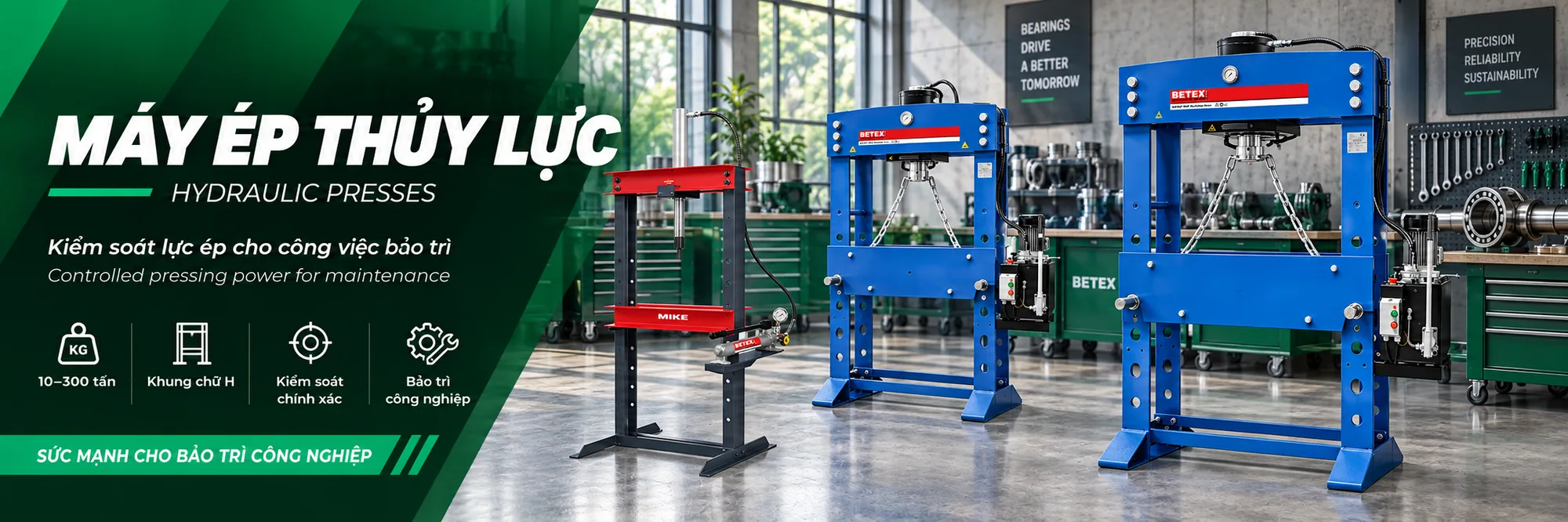
The hydraulic presses in this group cover 16 Schaeffler and BETEX codes, with pressing force from 10 tons to 300 tons. Most use an H-frame design, alongside the PFPE gantry frame type. Power units are available in hand-operated, foot-operated or electric pump versions. WSP-10 works at 700 bar with a cylinder stroke of 250mm. WSPE100 delivers 100 tons of pressing force at a maximum pressure of 258 bar.
Some codes such as HWS150 are used for mounting and dismounting railway bearings. The content below is grouped by pressing force level, cylinder type and how to select a configuration. These hydraulic press lines suit mechanical workshops, maintenance units and the railway sector. Genuine goods, with warranty according to import and distribution policy.


Hydraulic presses in this group include 16 Schaeffler and BETEX codes, with pressing force from 10 tons to 300 tons. Most follow the H-frame type, alongside the PFPE gantry-frame version. Power units are available in hand-operated, foot-operated or electric-pump versions. WSP-10 works at 700 bar with a cylinder stroke of 250mm. WSPE100 delivers 100 tons of pressing force at a maximum pressure of 258 bar.
Some codes such as HWS150 are used for mounting and dismounting railway bearings. The content below groups models by pressing force level, cylinder type and how to select a configuration. These hydraulic press ranges suit mechanical workshops, maintenance units and the railway industry. Genuine goods, with warranty according to import and distribution policy.
Hydraulic presses in this product group include 16 codes, spanning pressing force from 10 tons to 300 tons. The models carry the Schaeffler and BETEX brands. The H-frame type accounts for the majority, alongside the gantry-frame version. Power units are available in hand-operated, foot-operated and electric versions. A few codes are designed specifically for mounting and dismounting railway bearings.
The specifications recorded directly for each code include maximum pressing force, working pressure and cylinder stroke. For example, WSP-10 works at 700 bar with a cylinder stroke of 250mm. Meanwhile, WSPE100 reaches 100 tons of pressing force at a maximum pressure of 258 bar. Users should check each figure before choosing a configuration.
The pressing force range determines the scope of work the press frame can handle. This group divides fairly clearly into three levels: under 50 tons, from 60 to 100 tons, and from 150 tons upwards. Each level comes with a different power unit type and cylinder stroke. Determining the load to be pressed helps narrow the model list from the very first step.
This level includes codes serving the pressing of small and medium parts in the workshop. WSP-10 reaches a maximum pressing force of 10 tons with a fixed cylinder. WSPM15 S160 W555 works at a maximum pressure of 382 bar. WSPM30 S160 W560 offers a 160mm stroke and a pressure of 374 bar. The 50-ton version WSPM50 S160 W750 keeps the 160mm stroke at a pressure of 399 bar.
At the mid level, the cylinder begins to shift to the movable type on the horizontal frame. WSP works at 700 bar with a 250mm stroke and has three power unit options. WSPE30 uses a 1.5kW electric pump, 3-phase 400V, 50Hz supply. WSPE60 reaches 60 tons with two speed stages. The 100-ton version WSPE100 runs a 2.2kW motor.
The high-load models are used for heavy parts and wide press tables. WSPE160 has two speed stages, a 3kW motor and 400V voltage. WSPE200 S400 W1300 works at a maximum pressure of 245 bar. WSPE300 S480 W1750 reaches 300 tons, a 480mm stroke and a 5.5kW motor. All three follow the H-frame type with the cylinder moving on the horizontal frame.
Two factors that strongly affect daily operation are the frame type and the cylinder arrangement. The H-frame appears in most codes in the group. The gantry-frame form comes with the PFPE range, using high-grade steel as described by the manufacturer. The cylinder may be fixed at the centre or move back and forth by means of a roller system.
Fixed-cylinder versions include WSP-10 and WSPM15 S160 W555. Movable-cylinder versions include WSP and WSPE160. On the WSPE160, the cylinder slides on the horizontal frame via rollers and has a locking pin at each position. This mechanism helps centre the workpiece without moving the part repeatedly.
The power unit determines operating speed and the electrical infrastructure required at the workshop. This group has three main drive types: hand pump, foot pump and electric pump. Some electric models also come with an auxiliary hand-operated power unit. For electric models, the supply specifications are usually stated clearly as 400V, 50Hz together with the corresponding motor power.
The WSPM codes operate the hydraulic pump by hand or by foot in a 2-in-1 arrangement. The code WSP allows a choice of hand pump, electric pump or air pump. For the electric versions, WSPE60 and WSPE100 both come with an auxiliary hand-operated power unit. The accessory 7513040 serves foot control for electrically driven presses.
Some configurations in the group are designed for specific tasks rather than general use. The railway segment focuses on pressing wheels, bearings, brake discs and tapered roller bearings. The sheet metal working segment targets bending, straightening and forming large workpieces. These models differ in the machine frame and the accompanying fixtures.
The code HWS150 serves the pressing of wheels together with bearings, brake discs and railway gears, designed to customer requirements. The code 7550100 is used for mounting and dismounting seals on TAROL tapered roller bearing units of railway wagon wheel axles. The PFPE range in gantry-frame form has a capacity of 100 to 160 tons, operated electrically or by hand.
The first step is to determine the pressing force required for the heaviest part in the workshop. Then compare the cylinder stroke with the height and travel of the workpiece. Next comes choosing the power unit type based on working frequency and the available power supply. At the final step, consider a fixed or movable cylinder according to the press table layout.
For small maintenance workshops, codes under 50 tons using a hand pump or foot pump are sufficient. Workshops needing continuous pressing should look at the electric two-speed versions. The PFPE S450 version has three variants of 150 tons, 220 tons and 300 tons for bending and straightening large metal sheets.
You can open each code above to view details of pressing force, pressure, stroke and power unit configuration. When you need advice on a configuration for a specific part to be pressed, please contact the BETEX technical team.